Proprietary Blends Explained: What Viril Edge's 838 mg Total Does (and Doesn't) Tell You
Quick Answer: What Does "838 mg" Actually Mean on This Label?
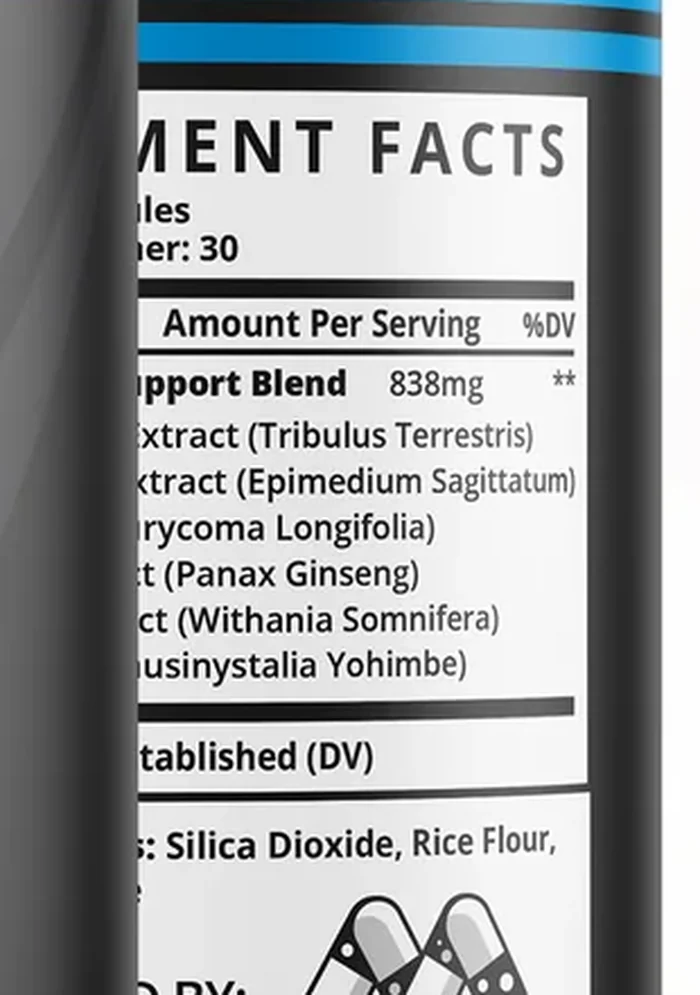
The Viril Edge Supplement Facts panel prints one number for the entire formula: "Proprietary Male Support Blend, 838 mg" per two-capsule serving, with "%DV not established." Underneath that single line sit six ingredient names — Tribulus Terrestris Extract, Horny Goat Weed Extract (Epimedium Sagittatum), Longjack Extract (Eurycoma Longifolia), Ginseng Root Extract (Panax Ginseng), Ashwagandha Extract (Withania Somnifera) and Yohimbe Extract (Pausinystalia Yohimbe) — listed in that printed order, with no individual milligram amount next to any of them. That is what a proprietary blend is: the total is disclosed, the split is not.
- What is disclosed: the blend total (838 mg), the six ingredient names, and their printed order.
- What is not disclosed: how many of those 838 mg belong to each ingredient, any extract ratio, and any standardization percentage.
- What that means for you: you cannot compare Viril Edge's dose of any single ingredient to the dose used in a published study, because that number does not exist on this label.
What a "proprietary blend" is, in plain terms
US dietary supplement labeling rules let a manufacturer group several ingredients under one name — here, "Proprietary Male Support Blend" — and state only the combined weight of the group, provided the ingredients inside it are listed afterward in descending order by weight. That is the entire compliance bar: an accurate total, an accurate ingredient list, and an order that reflects (at least loosely) how much of each is present relative to the others. Nothing in that rule requires the brand to say how the 838 mg actually splits between six botanicals that range from a common libido herb to a stimulant alkaloid with real pharmacology.
This is different from an itemized panel, where each ingredient gets its own line and its own milligram figure — the way, for example, a straightforward vitamin D or zinc supplement usually discloses its contents. Viril Edge does not do that. Every one of its active ingredients sits inside the single 838 mg bracket, which puts it firmly in "blend" territory rather than "itemized" territory.
The six ingredients, in the order the label prints them
Order matters here because it is the only ranking signal the label gives. Printed first-to-last:
| Printed position | Ingredient as printed | Amount disclosed? |
|---|---|---|
| 1 | Tribulus Terrestris Extract | No |
| 2 | Horny Goat Weed Extract (Epimedium Sagittatum) | No |
| 3 | Longjack Extract (Eurycoma Longifolia) | No |
| 4 | Ginseng Root Extract (Panax Ginseng) | No |
| 5 | Ashwagandha Extract (Withania Somnifera) | No |
| 6 | Yohimbe Extract (Pausinystalia Yohimbe) | No |
If the convention behind the labeling rule is followed, Tribulus Terrestris makes up the largest share of the 838 mg and Yohimbe Extract the smallest — but "largest" and "smallest" are relative positions, not numbers. Tribulus could be 400 mg and yohimbe 15 mg, or the six could be far closer together; nothing on this label lets a reader tell those two scenarios apart. The label also does not say whether the order is strictly by weight or simply the order the formulator chose to list them, so even the ranking should be read as a loose signal rather than a guarantee.
What "no individual amount" actually costs you as a reader
1. You cannot compare Viril Edge to a clinical trial dose
Published research on ingredients like Panax ginseng, ashwagandha or tribulus generally uses a specific, stated milligram dose of a specific, stated extract. To know whether Viril Edge is anywhere near that dose, you would need to know how many of the 838 mg are ginseng, or ashwagandha, or tribulus. The label does not say, so that comparison cannot be made — not "the dose is too low," not "the dose is adequate," simply unknown.
2. You cannot judge the yohimbe exposure
Yohimbe Extract is listed last, which under the standard convention suggests it is the smallest of the six by weight — but that is a relative ranking, not a safety threshold. Yohimbine, the alkaloid of pharmacological interest in yohimbe, has documented dose-dependent cardiovascular and psychiatric effects, and independent laboratory testing has repeatedly found real, sometimes pharmaceutical-level quantities of yohimbine in commercial supplements that do not print a milligram figure for it. A 2016 analysis published in Drug Testing and Analysis tested dietary supplements labeled with yohimbe or yohimbine and found actual content ranging from none detected up to doses in the range used therapeutically — with no way for a shopper to predict which end of that range a given bottle sits at from the label alone.[1] Because Viril Edge's panel gives no separate figure for its Yohimbe Extract, that same uncertainty applies here by definition, not by suspicion.
3. You cannot calculate a cost-per-effective-dose
A shopper comparing price per bottle against "how much of the ingredient I actually want am I getting" needs a number that this label does not supply for any of the six botanicals. Price-per-serving is calculable; price-per-milligram-of-any-single-ingredient is not.
Why manufacturers use blends at all
The industry-side reasons cited for proprietary blends generally boil down to two: protecting a specific formulation ratio from being copied by competitors, and — less charitably — making it possible to include a headline ingredient at a marketing-relevant name without disclosing that its actual dose is small. Both motives can coexist in the same label, and the panel alone cannot tell you which one applies to Viril Edge. A 2026 conceptual paper in The Journal of Nutrition proposes a framework for exactly this kind of "ingredient-interpretation gap" — the space between what a food or supplement label lists and what a reasonable shopper infers from that listing — and blends are one of the clearest examples of the gap it describes.[2]
What full disclosure would look like, for comparison
It helps to picture the alternative. A fully itemized panel for the same six ingredients would print something closer to: Tribulus Terrestris Extract 300 mg, Horny Goat Weed Extract 150 mg, Longjack Extract 120 mg, Ginseng Root Extract 100 mg, Ashwagandha Extract 100 mg, Yohimbe Extract 68 mg (numbers used here purely as a hypothetical illustration of the format, not a claim about Viril Edge's actual contents). With figures like that in hand, a reader could look up a published trial that used, say, 100 mg of a standardized ashwagandha extract, and compare it directly to what is in the bottle. Because Viril Edge prints only the 838 mg total, that comparison is unavailable for any of the six ingredients — not just yohimbe, all six.
Some supplement brands in this category do publish an itemized panel instead of a blend, and some publish a blend but disclose the yohimbe or other high-interest ingredient separately while keeping the rest bundled. Both of those formats give a reader more to work with than a single undifferentiated total. Viril Edge's label, as printed on the bottle examined for this article, uses the fully bundled format: one number, six names, no split.
Reading the rest of the panel alongside the blend line
The blend line is not the entire Supplement Facts panel. Above it, the label states Serving Size: 2 Capsules and Servings Per Container: 30, which lets you calculate the number of servings per bottle and per multi-bottle pack, even though it says nothing about the ingredient split. Below the blend, the label states "** Daily Value not established (DV)," a standard notation used because no official Daily Value exists for a combination-botanical blend of this kind. No vitamins, minerals or calories are listed on the panel at all — worth noting because a marketing bullet associated with the listing separately mentions "vitamins," a claim the printed Supplement Facts panel itself does not support. Reading the panel as a whole, rather than isolating the blend line, is a useful habit for any proprietary-blend product, not just this one.
How this differs from the "Third Party Tested" and "60 Days of Opening" questions
It is worth separating this issue from two others already covered on this site. Whether a "Third Party Tested" badge is backed by an actual certificate is a question about verification of whatever is on the label; read what a testing seal actually proves for that. Whether a bottle should be finished within 60 days of opening is a question about storage and stability once you already have the product; see why the bottle says 60 days for that one. This article is about a third, separate issue: even with a perfectly accurate, perfectly tested bottle in hand, the printed panel itself does not tell you how much of any one ingredient you are taking. That is a labeling-format question, not a testing or storage question.
What you can reasonably conclude, and what you cannot
You can reasonably conclude: Viril Edge contains all six named botanicals, in some amount, inside a combined 838 mg per two-capsule serving, and the order printed is a rough (not exact) indication of relative weight. You cannot reasonably conclude: the specific milligram amount of any one ingredient, whether that amount matches a dose used in a clinical trial, or the exact yohimbine content — because none of those numbers are on the label, and the fact pack behind this article found no manufacturer certificate of analysis, no published clinical trial on the finished Viril Edge formula, and no official Viril Edge manufacturer website that might otherwise supply that detail.
Medical note: general information, not medical advice. If you have had an unexpected reaction to a supplement, stop taking it and speak to a healthcare professional; adverse events can also be reported to the relevant national authority.
Scientific references
- Pharmaceutical quantities of yohimbine found in dietary supplements in the USA (Drug Test Anal, 2016)
- The Perception Filler: A Proposed Conceptual Framework for Ingredient-Interpretation Gaps in Food Supplements (J Nutr, 2026)
- Chromatographic fingerprint analysis of yohimbe bark and related dietary supplements using UHPLC/UV/MS (J Pharm Biomed Anal, 2012)
- Analysis of Select Dietary Supplement Products Marketed to Support or Boost the Immune System (JAMA Netw Open, 2022)
Frequently asked questions
What does the Viril Edge Supplement Facts panel actually print?
A single line, "Proprietary Male Support Blend, 838 mg" per 2-capsule serving, "%DV not established," followed by six ingredient names in printed order: Tribulus Terrestris Extract, Horny Goat Weed Extract (Epimedium Sagittatum), Longjack Extract (Eurycoma Longifolia), Ginseng Root Extract (Panax Ginseng), Ashwagandha Extract (Withania Somnifera) and Yohimbe Extract (Pausinystalia Yohimbe). No individual amount is printed for any of the six.
Is a proprietary blend illegal?
No. US labeling rules allow a manufacturer to disclose the total weight of a blend and list its ingredients in descending order by weight without stating each ingredient's individual amount, as long as the blend total and ingredient list are accurate.
Does ingredient order tell you the amount of each one?
It tells you the ranking, not the amount. Convention (and the labeling rule) is that ingredients are listed in descending order by weight, so Tribulus Terrestris is presumed to be present in the largest quantity and Yohimbe Extract in the smallest of the six, but no gap or ratio between them is disclosed.
Can you calculate the yohimbine dose in Viril Edge from the label?
No. The label states only that Yohimbe Extract is present somewhere inside the 838 mg total; it does not state the weight of the Yohimbe Extract itself or its percentage of yohimbine, so no milligram dose of yohimbine can be derived from the printed panel.
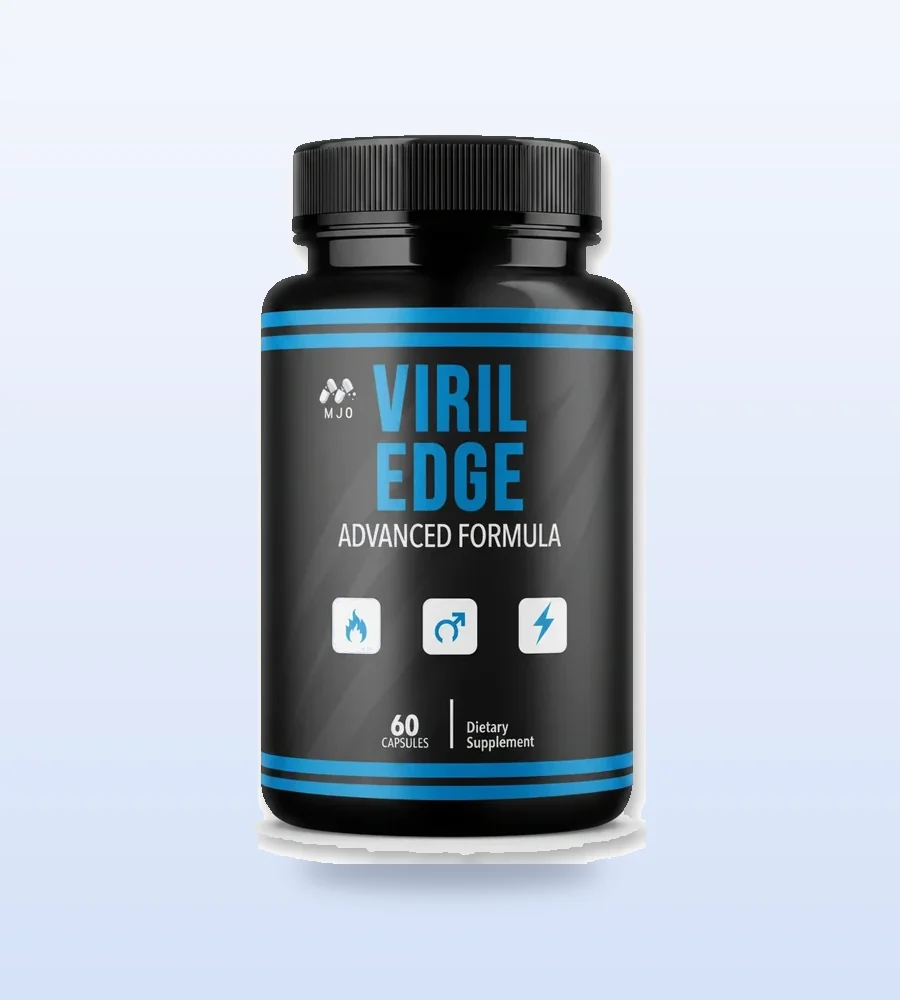
Read the whole label before you decide
The 838 mg blend total is one line on a longer panel. See the full ingredient list, suggested use and cautions on the product page.
Order Viril Edge